
Monday, 27 February 2012

Sunday, 26 February 2012
natural satellites......
A natural satellite or moon is a celestial body that orbits a
planet or smaller body, which is called its primary...

The Earth's one natural satellite, the Moon, is more than one quarter the size of Earth itself (3,474 km diameter). Because of its smaller size, the Moon's gravity is one-sixth of the Earth's gravity, as we saw demonstrated by the giant leaps of the Apollo astronauts.

While there are only two basic types of regions on the Moon's surface, there are many interesting surface features such as craters, mountain ranges, rilles, and lava plains. The structure of the Moon's interior is more difficult to study. The Moon's top layer is a rocky solid, perhaps 800 km thick. Beneath this layer is a partially molten zone. Although it is not known for certain, many lunar geologists believe the Moon may have a small iron core, even though the Moon has no magnetic field. By studying the Moon's surface and interior, geologists can learn about the Moon's geological history and its formation.

planet or smaller body, which is called its primary...
|

Moons of the Planets
This table lists all the moons of all the planets in our solar system. Every year new moons are discovered for the planets Jupiter, Saturn, Uranus and Neptune.
| Planet | Moons | Names of Moons |
| Mercury | 0 | - |
| Venus | 0 | - |
| Earth | 1 | Luna |
| Mars | 2 | Phobos, Deimos |
| Jupiter | 63 | Io, Europa, Ganymede, Callisto (Galilean moons); Amalthea, Himalia, Elara, Pasiphae,Sinope, Lysithea, Carme, Ananke, Leda; Metis, Adrastea (shepherd moons); Thebe, Callirrhoe, Themisto, Kalyke, Iocaste, Erinome, Harpalyke, Isonoe, Praxidike, Megaclite, Taygete, Chaldene, Autonoe, Thyone, Hermippe, Eurydome, Sponde, Pasithee, Euanthe, Kale, Orthosie, Euporie, Aitne (+ 25 other moons) |
| Saturn | 61 | Titan, Rhea, Iapetus, Dione, Tethys,Enceladus, Mimas, Hyperion; Prometheus, Pandora (shepherd moons); Phoebe, Janus, Epimetheus, Helene,Telesto, Calypso, Atlas, Pan, Ymir,Paaliaq, Siarnaq, Tarvos, Kiviuq, Ijiraq,Thrymr, Skathi, Mundilfari, Erriapo,Albiorox, Suttung (+ 30 other moons) |
| Uranus | 27 | Cordelia, Ophelia, (shepherd moons); Bianca, Cressida, Desdemona, Juliet,Portia, Rosalind, Belinda, Puck, Miranda,Ariel, Umbriel, Titania, Oberon, Caliban,Sycorax, Prospero, Setebos, Stephano, Trinculo (+ 6 unnamed moons) |
| Neptune | 13 | Triton, Nereid, Naiad, Thalassa, Despina,Larissa, Proteus, Galatea (shepherd moon) (+ 5 unnamed moons) |
| Pluto | 3 | Charon, Hydra, Nix |
The Earth's Moon Luna....
The Earth's one natural satellite, the Moon, is more than one quarter the size of Earth itself (3,474 km diameter). Because of its smaller size, the Moon's gravity is one-sixth of the Earth's gravity, as we saw demonstrated by the giant leaps of the Apollo astronauts.
While there are only two basic types of regions on the Moon's surface, there are many interesting surface features such as craters, mountain ranges, rilles, and lava plains. The structure of the Moon's interior is more difficult to study. The Moon's top layer is a rocky solid, perhaps 800 km thick. Beneath this layer is a partially molten zone. Although it is not known for certain, many lunar geologists believe the Moon may have a small iron core, even though the Moon has no magnetic field. By studying the Moon's surface and interior, geologists can learn about the Moon's geological history and its formation.
The footprints left by Apollo astronauts will last for centuries because there is no wind on the Moon. The Moon does not possess any atmosphere, so there is no weather as we are used to on Earth. Because there is no atmosphere to trap heat, the temperatures on the Moon are extreme, ranging from 100° C at noon to -173° C at night.
The Moon doesn't produce its own light, but looks bright because it reflects light from the Sun. Think of the Sun as a light bulb, and the Moon as a mirror, reflecting light from the light bulb. The lunar phase changes as the Moon orbits the Earth and different portions of its surface are illuminated by the Sun.
Friday, 24 February 2012
Satellites...............
A satellite is like an object which is lyk a secondary planet which revolves about another planet.......
satellites are classified as....
1. artificial satellites
2. natural satellites.
1.artificial satellites
The world's first artificial satellite, the Sputnik 1, was
launched by the Soviet Union on October 4 in 1957.
satellites are classified as....
1. artificial satellites
2. natural satellites.
1.artificial satellites
The world's first artificial satellite, the Sputnik 1, was
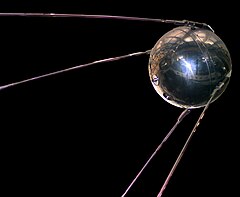 |
| The first artificial satellite to orbit Earth. |
Sputnik 1 helped to identify the density of high atmospheric layers through
measurement of its orbital change and provided data on radio-signal distribution in the
ionosphere. The unanticipated announcement of Sputnik 1's success precipitated the
Sputnik crisis in the United States and ignited the so-called Space Race within the Cold
War....
Since then, thousands of satellites have been
launched into orbit around the Earth; also some
satellites, notably space stations, have been launched in
parts and assembled in orbit. Artificial satellites originate
from more than 50 countries and have used the satellite
launching capabilities of ten nations. A few hundred
satellites are currently operational, whereas thousands of
unused satellites and satellite fragments orbit the Earth
as space debris. A fewspace probes have been placed
into orbit around other bodies and become artificial
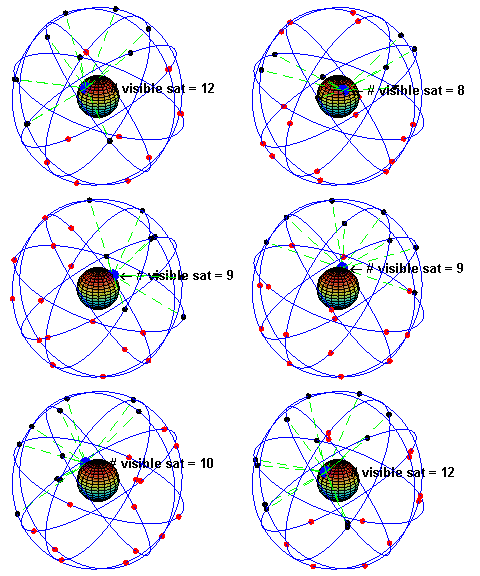 |
| An animation depicting the orbits of GPS satellites in medium Earth orbit. |
main uses.............
Satellites are used for a large number of purposes.
Common types include military and civilian Earth
observation satellites, communications satellites,
navigation satellites, weather satellites, and research
satellites. Space stations and human spacecraft in orbit
are also satellites. Satellite orbits vary greatly, depending
on the purpose of the satellite, and are classified in a
number of ways. Well-known (overlapping) classes
include low Earth orbit, polar orbit, and geostationary
Satellites are usually semi-independent computer-
controlled systems. Satellite subsystems attend many
tasks, such as power generation, thermal control,
telemetry, attitude control and orbit control.
Wednesday, 22 February 2012
Feng shui
Historically, feng shui was widely used to orient buildings—often spiritually
significant structures such as tombs, but also dwellings and other structures—in an
auspicious manner. Depending on the particular style of feng shui being used, an
auspicious site could be determined by reference to local features such as bodies of
water, stars, or a compass. Feng shui was suppressed in China during the cultural
revolution in the 1960s, but since then has increased in popularity.
Modern reactions to feng shui are mixed. The Skeptic encyclopedia of pseudoscience
states that some principles of feng shui are "quite rational", while noting that "folk
remedies and superstitions... [have been] incorporated into feng shui's eclectic mix....
Today, feng shui is practiced not only by the Chinese, but also by Westerners.
However, with the passage of time and feng shui's popularization in the West, much of
the theory behind it has been lost in translation, not paid proper attention to, frowned
upon, or scorned.
... feng shui has become an aspect of interior decorating in the Western world and
alleged masters of feng shui now hire themselves out for hefty sums to tell people
such as Donald Trump which way his doors and other things should hang. Feng shui
has also become another New Age "energy" scam with arrays of metaphysical
products ... offered for sale to help you improve your health, maximize your potential,
and guarantee fulfillment of some fortune cookie philosophy.
Others have noted how, when feng shui is not applied properly, or rather, without
common sense, it can even harm the environment, such as was the case of people
planting "lucky bamboo" in ecosystems that could not handle them
The practice of Feng Shui is diverse and multi-faceted. There are many different
schools and perspectives. The International Feng Shui Guild (IFSG) is a non-profit
professional organization that presents the full diversity of Feng Shui.
Recent developments
A growing body of research exists on the traditional forms of feng shui used and taught in Asia
Environmental scientists and landscape architects have researched traditional feng shui and its methodologies
Architects study feng shui as an ancient and uniquely Asian architectural tradition
Geographers have analyzed the techniques and methods to help locate historical sites
in Victoria, Canada and archaeological sites in the American Southwest, concluding
that ancient Native Americans considered astronomy and landscape features.
Monday, 20 February 2012
find it out........:)
Anything that makes you weak....
physically, intellectually, and..... spiritually,
reject it as poision.............
physically, intellectually, and..... spiritually,
reject it as poision.............
Sunday, 19 February 2012
Failures?????
Never mind failures ,they are quite natural,
They are the beauty of life ,what would life be
without them????
Saturday, 18 February 2012
POWER YOUR MIND!...
As your thoughts.........
So your mind............
Sow good thoughts........
Power your mind....... :)
Subscribe to:
Posts (Atom)