Monday, 25 June 2012

fabrication.....


how an ic is fabricated?


must watch dis....... very very useful....

Sunday, 26 February 2012

natural satellites......

A natural satellite or moon is a celestial body that orbits a 


planet or smaller body, which is called its primary...


The Moon


The Moon l  Last Quarter Moon


Moons of the Planets

This table lists all the moons of all the planets in our solar system. Every year new moons are discovered for the planets Jupiter, Saturn, Uranus and Neptune.


PlanetMoons  Names of Moons
Mercury0-
Venus0-
Earth1Luna
Mars2PhobosDeimos
Jupiter63IoEuropaGanymedeCallisto (Galilean moons);
AmaltheaHimaliaElaraPasiphae,SinopeLysitheaCarmeAnankeLeda;
MetisAdrastea (shepherd moons);
Thebe, Callirrhoe, Themisto, Kalyke, Iocaste, Erinome, Harpalyke, Isonoe, Praxidike, Megaclite, Taygete, Chaldene, Autonoe, Thyone, Hermippe, Eurydome, Sponde, Pasithee, Euanthe, Kale, Orthosie, Euporie, Aitne
(+ 25 other moons)
Saturn61TitanRheaIapetusDioneTethys,EnceladusMimasHyperion;
PrometheusPandora (shepherd moons);
PhoebeJanusEpimetheusHelene,TelestoCalypsoAtlasPanYmir,PaaliaqSiarnaqTarvosKiviuqIjiraq,ThrymrSkathiMundilfariErriapo,AlbioroxSuttung
(+ 30 other moons)
Uranus27CordeliaOphelia(shepherd moons);
BiancaCressidaDesdemonaJuliet,PortiaRosalindBelindaPuckMiranda,ArielUmbrielTitaniaOberonCaliban,SycoraxProsperoSetebosStephano, Trinculo
(+ 6 unnamed moons)
Neptune13TritonNereidNaiadThalassaDespina,LarissaProteusGalatea (shepherd moon)
(+ 5 unnamed moons)
Pluto3Charon, Hydra, Nix


The Earth's Moon Luna....


   The Earth's one natural satellite, the Moon, is more than one quarter the size of Earth itself (3,474 km diameter). Because of its smaller size, the Moon's gravity is one-sixth of the Earth's gravity, as we saw demonstrated by the giant leaps of the Apollo astronauts. 


       While there are only two basic types of regions on the Moon's surface, there are many interesting surface features such as craters, mountain ranges, rilles, and lava plains. The structure of the Moon's interior is more difficult to study. The Moon's top layer is a rocky solid, perhaps 800 km thick. Beneath this layer is a partially molten zone. Although it is not known for certain, many lunar geologists believe the Moon may have a small iron core, even though the Moon has no magnetic field. By studying the Moon's surface and interior, geologists can learn about the Moon's geological history and its formation.
The footprints left by Apollo astronauts will last for centuries because there is no wind on the Moon. The Moon does not possess any atmosphere, so there is no weather as we are used to on Earth. Because there is no atmosphere to trap heat, the temperatures on the Moon are extreme, ranging from 100° C at noon to -173° C at night.
The Moon doesn't produce its own light, but looks bright because it reflects light from the Sun. Think of the Sun as a light bulb, and the Moon as a mirror, reflecting light from the light bulb. The lunar phase changes as the Moon orbits the Earth and different portions of its surface are illuminated by the Sun. 


Friday, 24 February 2012

Satellites...............

           satellite is like an object which is lyk a secondary planet which revolves about another planet.......


    satellites  are classified as.... 


       1. artificial satellites
       2. natural satellites.


1.artificial satellites


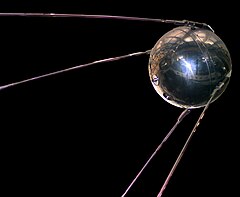
The world's first artificial satellite, the Sputnik 1, was 

launched by the Soviet Union  on October 4 in 1957.


 The first artificial satellite to orbit Earth.
Sputnik 1 helped to identify the density of high atmospheric layers through 

measurement of its orbital change and provided data on radio-signal distribution in the 

ionosphere. The unanticipated announcement of Sputnik 1's success precipitated the 

Sputnik crisis in the United States and ignited the so-called Space Race within the Cold 

War....

       Since then, thousands of satellites have been 

launched into orbit around the Earth; also some 

satellites, notably space stations, have been launched in 

parts and assembled in orbit. Artificial satellites originate 

from more than 50 countries and have used the satellite 

launching capabilities of ten nations. A few hundred 

satellites are currently operational, whereas thousands of 

unused satellites and satellite fragments orbit the Earth 

as space debris. A fewspace probes have been placed 

into orbit around other bodies and become artificial 

satellites to the Moon, MercuryVenusMarsJupiter

Saturn, and the Sun.

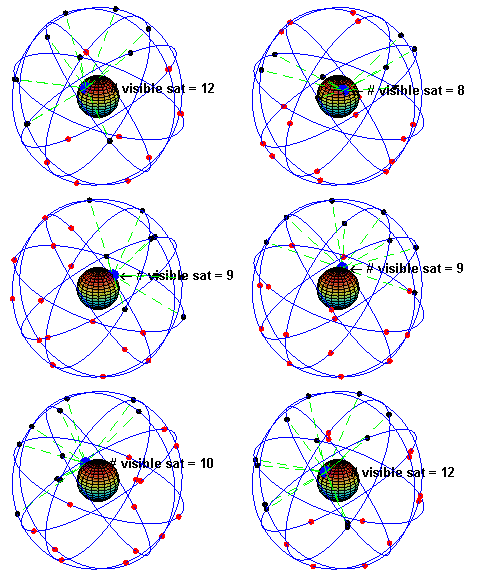
An animation depicting the orbits of GPS satellites in medium Earth orbit.


main uses.............

Satellites are used for a large number of purposes. 

Common types include military and civilian Earth 

observation satellites, communications satellites

navigation satellites, weather satellites, and research 

satellites. Space stations and human spacecraft in orbit 

are also satellites. Satellite orbits vary greatly, depending 

on the purpose of the satellite, and are classified in a 

number of ways. Well-known (overlapping) classes 


Satellites are usually semi-independent computer-

controlled systems. Satellite subsystems attend many 

tasks, such as power generation, thermal control, 

telemetry, attitude control and orbit control.


Wednesday, 22 February 2012

Feng shui


     Historically, feng shui was widely used to orient buildings—often spiritually 
significant structures such as tombs, but also dwellings and other structures—in an 
auspicious manner. Depending on the particular style of feng shui being used, an 
auspicious site could be determined by reference to local features such as bodies of 
water, stars, or a compass. Feng shui was suppressed in China during the cultural 
revolution in the 1960s, but since then has increased in popularity.

    Modern reactions to feng shui are mixed. The Skeptic encyclopedia of pseudoscience 
states that some principles of feng shui are "quite rational", while noting that "folk 
remedies and superstitions... [have been] incorporated into feng shui's eclectic mix....

    Today, feng shui is practiced not only by the Chinese, but also by Westerners. 
However, with the passage of time and feng shui's popularization in the West, much of 
the theory behind it has been lost in translation, not paid proper attention to, frowned 
upon, or scorned.

... feng shui has become an aspect of interior decorating in the Western world and 
alleged masters of feng shui now hire themselves out for hefty sums to tell people 
such as Donald Trump which way his doors and other things should hang. Feng shui 
has also become another New Age "energy" scam with arrays of metaphysical 
products ... offered for sale to help you improve your health, maximize your potential, 
and guarantee fulfillment of some fortune cookie philosophy.
    
Others have noted how, when feng shui is not applied properly, or rather, without 
common sense, it can even harm the environment, such as was the case of people 
planting "lucky bamboo" in ecosystems that could not handle them
   
    The practice of Feng Shui is diverse and multi-faceted. There are many different 
schools and perspectives. The International Feng Shui Guild (IFSG) is a non-profit 
professional organization that presents the full diversity of Feng Shui.

Recent developments

A growing body of research exists on the traditional forms of feng shui used and taught in Asia

Environmental scientists and landscape architects have researched traditional feng shui and its methodologies 

Architects study feng shui as an ancient and uniquely Asian architectural tradition

Geographers have analyzed the techniques and methods to help locate historical sites 

in Victoria, Canada and archaeological sites in the American Southwest, concluding 

that ancient Native Americans considered  astronomy and landscape features.


Monday, 20 February 2012

find it out........:)

Anything  that  makes  you  weak....   
             physically, intellectually, and.....  spiritually,
                       reject it as poision.............

Sunday, 19 February 2012

Failures?????


Never mind failures ,they are quite natural,


They are the beauty of life ,what would life be 
                      without them????

Saturday, 18 February 2012

POWER YOUR MIND!...


 As your thoughts.........
        So your mind............
                Sow good thoughts........
                        Power your mind....... :)      

Saturday, 14 January 2012

B positive......

1   TREE   MAKES   1  LAKH   MATCHSTICKS   ..   


BUT   1   MATCHSTICK   CAN   BURN   1   


LAKH   TREES..... 
  
SIMILARLY    1   NEGATIVE   THOUGHT   OR   


DOUBT   CAN   BURN   THOUSANDS   OF   


DREAMS.  ... 


SOO   ...B   POSITIVE.  .... LIFE   ROCKZZZ....

Thursday, 12 January 2012

WATER DROP LENS!......

 Physicist and inventor,Burno Berge, has created  liquid optical lens.


Using  process known as electro-wetting  water drop is deposited on metal substrate and covered by  thin 


insulting layer.When  voltage is applied to the metal,it modifies the angle of the liquid drop.


The liquid lens is comprised of two liquids, water and oil,one is  conductor while the other is an insulator. 


variation in the voltage causes  change to the curvature of the liquid to liquid interface,which changes the focal 


length of the lens.


The use of liquids allows for low cost construction.There re no moving parts and electrical consumption is 


extremely low.The lens has  large inverse focal length range,quick response,high optical quality and can 


operate in  wide temperature range.....

Wednesday, 11 January 2012

just a brief note on fiber optics.....

  
Fiber optics is very fine filaments of transparent glass covered 


with a plastic material that transmits light long its axis by the 


process of total internal reflection.They are flexible and 


resistant .They are used to illuminate and to observe places that 


are not easily reached(inside the human body,for example) or to 


transmit coded information in the form of light signals(for 


example,in telephonic network).Due to the high speed of 


transmission, approximately two or three times the speed of 


light and the ability to transfer  remarkable volume of 


information,fiber optics are the method of communication for 


the future.Fiber optics is used to look inside the human body. 


Because they are so fine and flexible,they can reach parts of the 


body,which could not be otherwise reached without 


surgery.Fiber optics can illuminate  part of the body and 


transmit images to the doctor who can see these on  separate and 


external screen.These re used s hydrophones for seismic and 


SONAR uses,s wiring in aircraft, submarines and other vehicles 


and also for field networking.

Tuesday, 10 January 2012

Deadly Water pistols ....

         Archerfish have been shown by  team t the university of 


Erlangen in Germany to be even more impressive at squirting 


jets of water at prey than previously realized.It is not a question 


of fire and hope the fish re deadly accurate and can calculate the 


quantity of water needed to dislodge each unfortunate creature 


chosen for supper. The quantity of water spat t the prey-


generally  flies,beetles and spiders and occasionally small lizards 


is judged according to size. Researches found that the fish 


consistently squirted bout ten times as much as was needed to 


knock the chosen prey into the water where it could be snapped 


up.


      The archer fish's hunting technique is costly in terms of 


energy expended,so it limits wasted effort by altering the mount 


of water expelled according to the creature it intends to dislodge 


from an overhanging part. Of course,using ten times s much 


water as is required would seem to be  built in safety margins to 


maximize the chances of success.


         The findings came just years after it was demonstrated that 


archerfish can assess not just the sie and position of the 


target,but can also take account of distortion caused by light 


striking the water.

Monday, 9 January 2012

HOW ARE HURRICANES NAMED..???


THREE ITEMS
1, HOW ARE HURRICANES NAMED
2 IRENE'S IMPACT ON NEW JERSEY
3.IRENE'S IMPACT ON NEW YORK.
ALL WORTH SPENDING SOME TIME ON.


Hurricane Gustav has raged with speed of 140 miles per hour. It is followed by Hanna, Ike and Josephine.
 You will find an explanation below of how hurricanes are named and categorised. PPR 
                                **************************
 Currently, there are six separate 21-name lists and each of them is used every six years in a rotation. They don't include names that begin with Q,U,X,Y and Z because there aren't enough names starting with those letters.

There has been 21 tropical storms and hurricanes in the 
Atlantic.  A storm name is retired if it causes widespread damage and deaths. So if there is a deadly hurricane Alpha, what is it replaced with when it's retired?

 Actually, when old names are retired, new names have to be drafted in to a database maintained specifically for Atlantic ocean storms, said Mark Oliver, spokesman for the world meteorological organization in 
GenevaSwitzerland, which maintains the database.
"There are  certain specifications which they have to meet," Oliver said. "they have to be fairly easily remembered, they've got to be in alphabetical order."
For several hundred years, damaging hurricanes were named after the Saint's Day when the storm hit. For example, there was Hurricane 
Santa Ana which hit Puerto Rico on July 26, 1825. According to the U.S. conference of catholic bishops, there are Saint's days for about a third to a half of all days.

Then, Australian meteorologist Clement Wragge began giving women's names to tropical storms before the end of the 19th century, according to the National Weather Service.

Other regions take a different approach. In 
Asia, storms may be given names of people, but also of flowers or other non-human beings, Oliver said. Japan does not participate in this system, preferring instead to number each storm chronologically starting a new each year.

During World War I I, storm naming became more common, especially among Air Force and Navy meteorologists who tracked storms over the 
Pacific Ocean.

From 1950 to 1952, the 
United States named storms by a phonetic alphabet, starting with Able, Baker and Charlie. That became confusing because the same names were used each year, so female names were used starting in 1953 in a list created by the NationalHurricane Center. The first one was called tropical storm Alice.

That was considered biased against women, so men's names were added in 1978 in the Pacific and a year later in the 
Atlantic, with Hurricane Bob. 

There have been six lists of names in use since 1979 (list i). The lists make use of names from both sexes. They are in alphabetical order and lists are recycled after six years, with list vi in use for the 2008 season,

Gender alternates both between adjacent names in a list (a male name is followed by a female one and vice versa) and between initial names between lists (if one year's list starts with a female name, the next year's list begins with a male one and vice versa).
If the names on a list are all used, storms are then named after the letters of the Greek alphabet (alpha, beta, gamma, etc.) Greek names, unlike the names in the regular lists, cannot be retired. In case a storm reached the magnitude that might otherwise have lead to retirement, the storm would be listed with the retired names with a footnote indicating the Greek letter would still be available for future storms. The use of 21 names was established in reference to the1933 Atlantic hurricane season which had been the record holder for the most storms in the region. This record was broken during the 2005 season which saw 28 storms (27 named Andone unnamed), and saw the first use of the Greek alphabet to name storms.
List 1         List 2         List 3        List 4       List 5         List 6
• Ana
• Bill
• Claudette
• Danny
• Erika
• Fred
• Grace
• Henri
• Ida
• Joaquin
• Kate
• Larry
• Mindy
• Nicholas
• Odette
• Peter
• Rose
• Sam
• Teresa
• Victor
• Wanda
• Alex
• Bonnie
• Colin
• Danielle
• Earl
• Fiona
• Gaston
• Hermine
• Igor
• Julia
• Karl
• Lisa
• Matthew
• Nicole
• Otto
• Paula
• Richard
• Shary
• Tomas
• Virginie
• Walter
• Arlene
• Bret
• Cindy
• Don
• Emily
• Franklin
• Gert
• Harvey
• Irene
• Jose
• Katrina
• Lee
• Maria
• Nate
• Ophelia
• Philippe
• Rina
• Sean
• Tammy
• Vince
• Whitney
• Alberto
• Beryl
• Chris
• Debby
• Ernesto
• Florence
• Gordon
• Helene
• Isaac
• Joyce
• Kirk
• Leslie
• Michael
• Nadine
• Oscar
• Patty
• Rafael
• Sandy
• Tony
• Valerie
• William
• Andrea
• Barry
• Chantal
• Dorian
• Erin
• Fernand
• Gabrielle
• Humberto
• Ingrid
• Jerry
• Karen
• Lorenzo
• Melissa
• Nestor
• Olga
• Pablo
• Rebekah
• Sebastian
• Tanya
• Van
• Wendy
• Arthur
• Bertha
• Cristobal
• Dolly
• Edouard
• Fay
• Gustav
• Hanna
• Ike
• Josephine
• Kyle
• Laura
• Marco
• Nana
• Omar
• Paloma
• Rene
• Sally
• Teddy
• Vicky
• Wilfred
******************************************************
                                     Categories for hurricanes
                             Have you ever wondered what exactly the forecasters mean when they say a hurricane is a category 1 or category 4? Hurricanes are classifed based on categories of intensity. These categories tell people what kind of damage the storm could cause.
                            A tropical storm officially becomes a hurricane once it reaches winds of 75mph or greater. Once this happens the hurricane is then given a category based on how powerful the winds are. The category also gives an idea as to how likely the damage will be for flooding and structural damage once the hurricane hits land. Hurricanes are measured on the "saffir-simpson" scale. The scale was named after the two men that came up with this way to measure hurricanes. Herbert Saffir was an engineer in 
Florida and Robert Simpson was the Director of the National Hurricane Center from 1967 through 1973. 


The scale has five categories which are:

Category 1

 A category one hurricane has winds ranging in speed from 75 to 95 mph. A category 1 hurricane usually causes some minor flooding and damage to trees and some structural damage to buildings.

Some category 1 hurricanes were: hurricane allison 1995, hurricane danny 1997, hurricane lili in 2002, hurricane gaston in 2004.

Category 2

 Category 2 storms have winds 96 to 110 mph. A category 2 hurricane will cause some structural damage usually ripping tiles off roofs, damaging windows and causing tree damage and possibly knocking down power lines. Mobile homes also will usually see a great deal of damage done to the home. Minor flooding can be expected with a category 2 storm.
Some category 2 hurricanes were: hurricane Kate in 1985, hurricane Bob in 1991, hurricane Bertha in 1996, hurricane Isabel in 2003, hurricane 
Frances in 2004.

Category 3

 Any hurricane that is a category 3 or higher is considered a major hurricane.
 A category 3 hurricane is a hurricane in which you should evacuate from your area and move to an area away from the hurricane. Category 3 hurricanes have winds of 111 to 130 mph. Category 3 hurricanes can cause tree damage, building damage and mobile homes could be destroyed.
Some category 3 hurricanes were: hurricane Alicia in 1983, hurricane Roxanne in 1995, Fran in 1996, hurricane Jeanne and hurricane Ivan in 2004.

Category 4

Category 4 hurricanes are powerful with winds of 131 to 155 mph. Category 4 hurricanes can cause damage to all types of buildings. Tree and sign damage can also be expected. Mobile homes will be destroyed. Flooding is usually severe with a category 4 storm.
Some category 4 hurricanes were: hurricane Felix and hurricane Opal both in 1995 hurricane Hugo in 1989 and hurricane Katrina in 2005.

 Category 5

 Category 5 storms are the most powerful hurricanes on the earth. We are lucky that these hurricanes are rare and we have only had three category 5 hurricanes ever hit the 
United states. Category 5 storms have winds of 156 mph and over. Category 5 storms will cause heavy structural damage to most buildings and mobile homes will be destroyed. Trees and signs will be blown down. Category 5 hurricanes will also cause severe flooding with storm surges at 18 feet or higher.

The only 3 category 5 hurricanes to ever make landfall in the United States since the record keeping began are: Labor day hurricane of 1935 that hit the Florida Keys, hurricane Camile in 1969, and hurricane Andrew in 1992.